
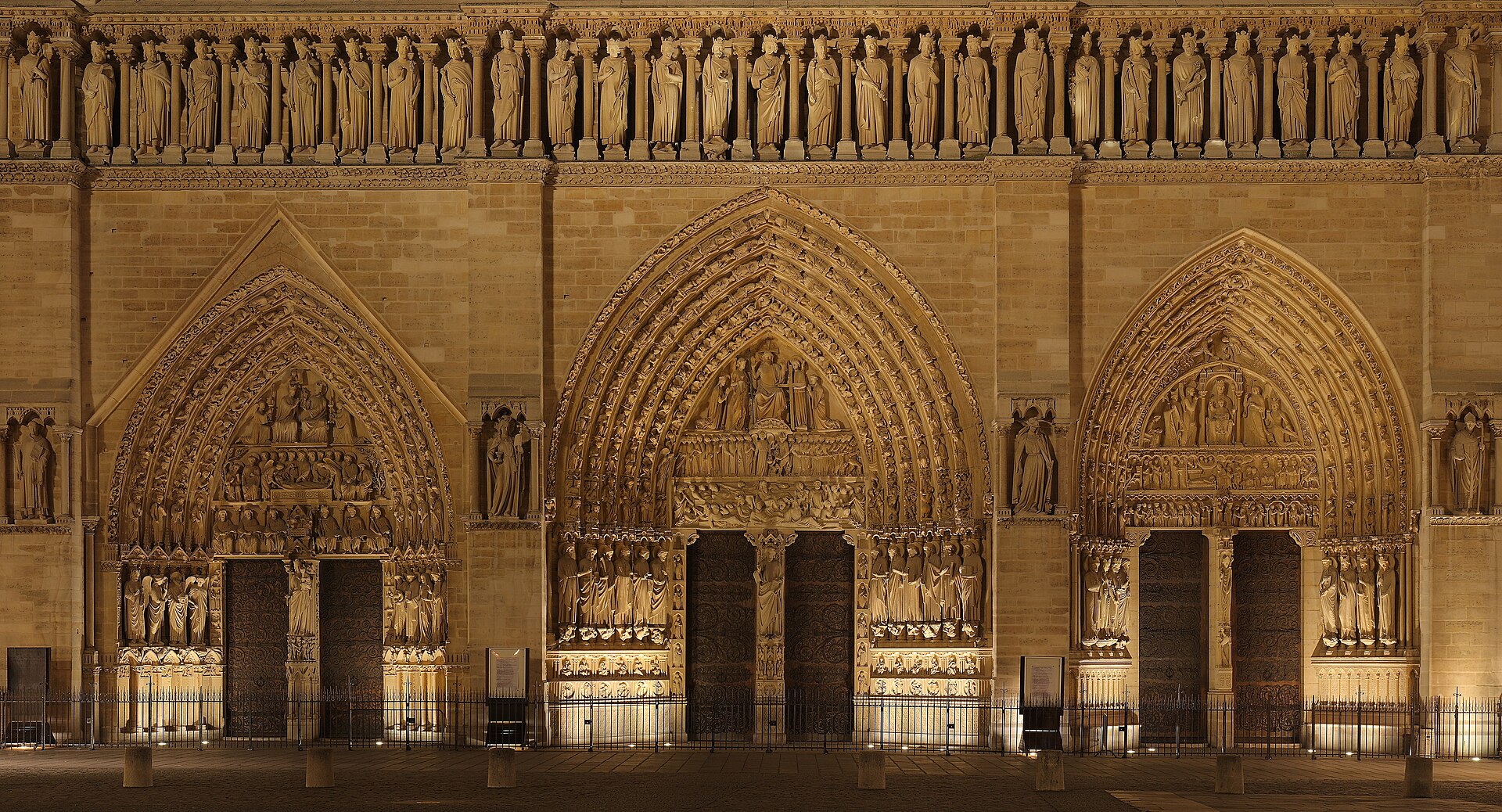
Notre-Dame Cathedral
- sacred
- Price: Free (bell towers €16)
- Opening hours: Mon-Fri 07:50-19:00, Sat-Sun 08:15-19:30 (free, reservation recommended)
History
Construction began in 1163 under Bishop Maurice de Sully and continued for nearly two centuries, making Notre-Dame one of the earliest buildings to fully exploit the Gothic system of flying buttresses. By carrying the weight of the roof outward and down through external stone arches, those buttresses freed the walls from having to bear the load themselves, letting architects open them up into enormous stained-glass windows, including the cathedral's famous rose windows, while pushing the vaults ever higher.
Over the centuries the cathedral became inseparable from French national life: French kings were crowned here, and Napoleon staged his self-coronation as emperor within its walls in 1804. Its fortunes dipped badly after the Revolution, when the building was vandalized and left to decay, until Victor Hugo's 1831 novel "Notre-Dame de Paris" rekindled public affection for it and helped spark a major 19th-century restoration led by the architect Eugène Viollet-le-Duc — who, among other changes, added the slender spire that would later collapse in the 2019 fire.
Restoration
On 15 April 2019, a fire broke out in the cathedral's roof and spread with terrifying speed through the centuries-old oak framework, known as "the forest" for the sheer number of timbers packed into it. Viollet-le-Duc's spire toppled in front of a horrified, watching world, and for a few hours it seemed the whole cathedral might be lost — but firefighters managed to save the twin bell towers and the stone structure itself, and France's president pledged, that same week, to rebuild within five years.
What followed was one of the largest heritage restoration projects in modern history: roughly 2,000 craftspeople — carpenters, stonemasons, glaziers, sculptors — worked on it, many using the same traditional techniques as the original builders, including oak beams hand-hewn with axes rather than cut by machine. Notre-Dame reopened to the public on 7-8 December 2024, its stone and paintings cleaned of centuries of grime and candle soot, revealing an interior that visitors and restorers alike have described as more luminous than anyone living had ever seen it.
Did you know?
Notre-Dame means "Our Lady," and the cathedral is dedicated to the Virgin Mary, but visitors are often more struck by its gargoyles and grotesques — stone creatures perched along the roofline that mostly aren't medieval at all. Nearly all of the ones seen today were added during Viollet-le-Duc's 19th-century restoration, including his own self-portrait carved discreetly among the figures watching over the transept.
Its full-time population isn't only architectural: colonies of bees have kept hives on a nearby rooftop for years, producing honey sold to support conservation work, and the cathedral survived not only the 2019 fire but the far worse destruction of two world wars that reduced much of the surrounding region to rubble.
Good to know
Entry to the nave is free, but reserving a timed slot online in advance is strongly recommended, especially in peak season, since queues can otherwise stretch a long way outside on the parvis. Mass and services still take place regularly, so visiting hours vary somewhat around them.
The bell towers — reachable via around 400 steps and offering close-up views of the gargoyles and the bells themselves — are ticketed separately from the free nave visit and often need to be booked well ahead, particularly in summer.