
Louvre Museum
- art-museum
- museum
- Price: €22
- Opening hours: Wed-Mon 09:00 - 18:00, closed Tue
History
The Louvre began life as a medieval fortress built around 1190 to defend Paris against the threat of English attack from the west; its stone foundations, complete with a moat and a circular keep, are still visible in the museum's basement today. Over the following four centuries, French kings gradually transformed the fortress into a royal palace, adding wings and courtyards in whatever style was fashionable at the time.
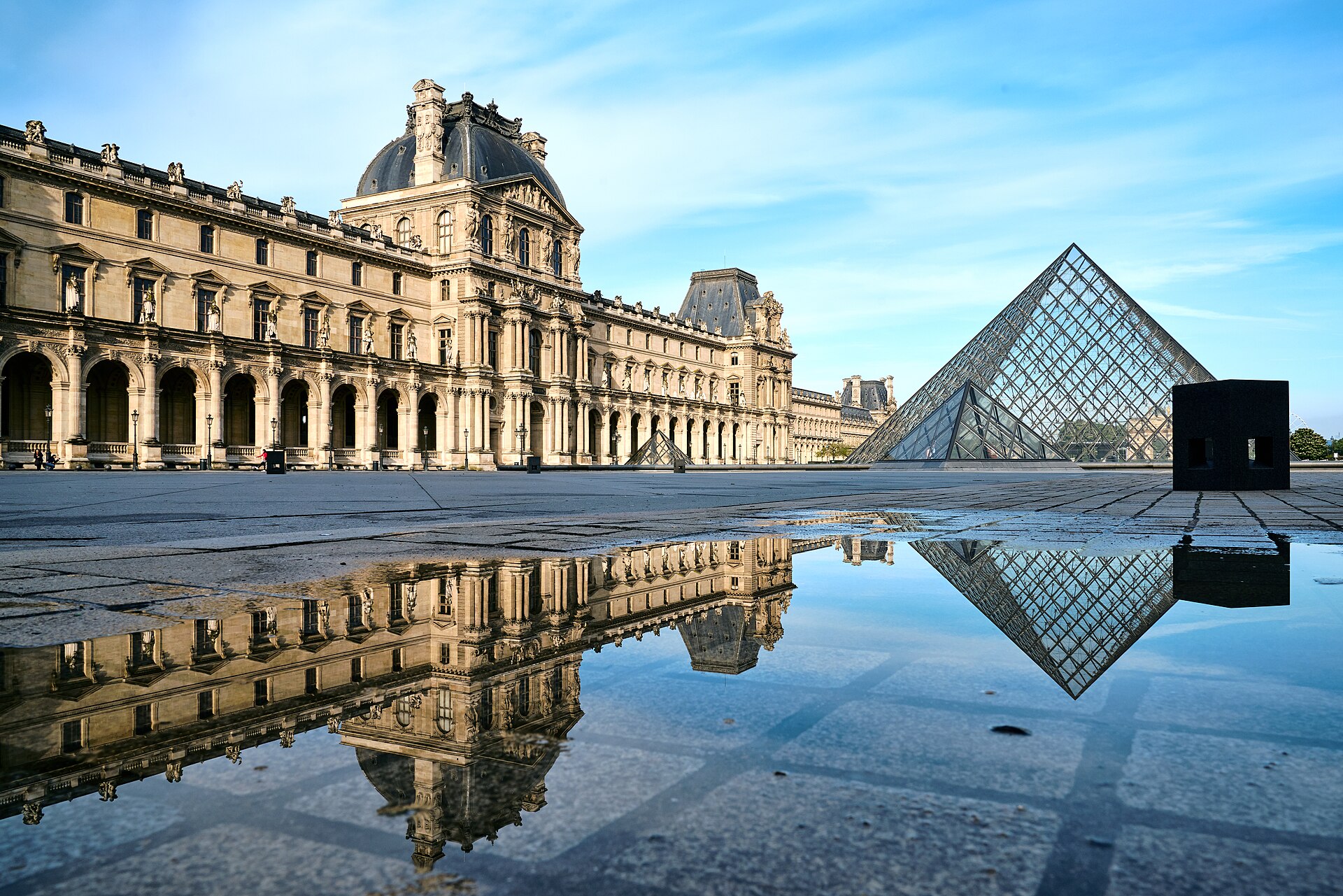
It became a public museum in 1793, during the Revolution, when the new government opened the former royal art collection to ordinary citizens as a deliberate statement that culture belonged to the nation, not the crown. Nearly two centuries later, I. M. Pei's glass pyramid was added as the museum's new main entrance in 1989; fiercely controversial at the time for clashing with the historic courtyard around it, it has since become one of Paris's most recognisable landmarks in its own right.
Masterpieces
The collection spans nine millennia across departments devoted to Egyptian, Near Eastern, Greek and Roman antiquities, European painting and sculpture, and decorative arts — one of the broadest surveys of human creativity ever assembled under a single roof.
Most visitors make a beeline for three works in particular: the Mona Lisa, kept behind protective glass in the Salle des États and drawing larger crowds than any other single artwork on the planet; the armless Venus de Milo, a Hellenistic sculpture whose missing limbs have only added to its mystery; and the Winged Victory of Samothrace, poised dramatically at the top of a grand staircase as though still cutting through the wind on the prow of a ship.
Did you know?
With roughly 73,000 square metres of exhibition space, the Louvre is so vast that seeing everything in a single visit is essentially impossible — even a tightly planned itinerary through only the highlights can take a full day.
Beneath the museum, in the Sully wing, visitors can walk among the excavated stone walls, towers and moat of the original medieval fortress, uncovered during renovation work in the 1980s — a genuinely atmospheric detour that most tourists rushing toward the Mona Lisa never think to take.
Good to know
Pre-booking a timed ticket is essential, especially in high season, since walk-up queues can stretch for hours. If your time is limited, it's worth planning a route around the three or four works you most want to see — the Mona Lisa, Venus de Milo and Winged Victory of Samothrace are a solid starting point — rather than trying to cover every wing.
The glass pyramid isn't the only way in: the underground Carrousel du Louvre entrance, reached via the Tuileries or Rue de Rivoli, is typically far less crowded, and the Porte des Lions offers another alternative when it's open, though its hours are irregular and it's best treated as a bonus rather than a guaranteed option.