
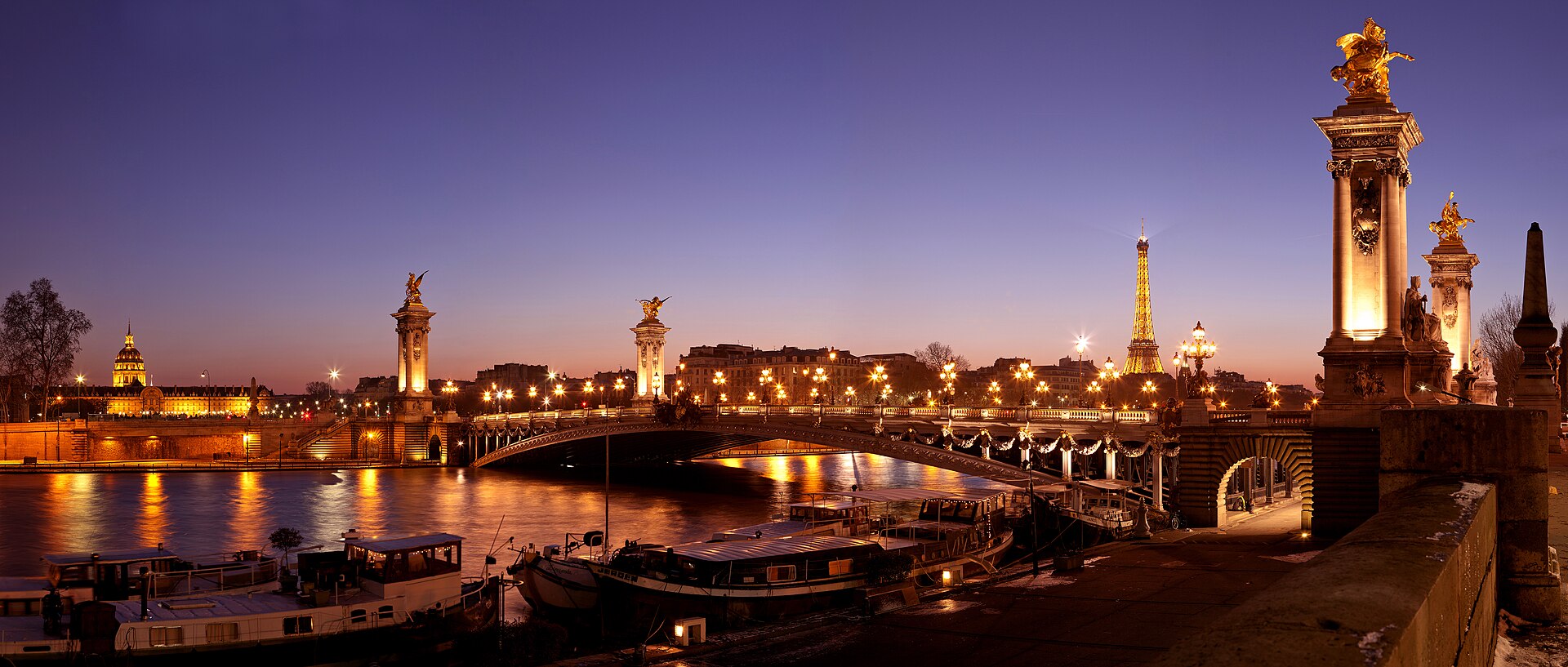
Pont Alexandre III
- bridge
- Price: Free
- Opening hours: Always open (bridge)
Book a guided tour of Paris
Skip the line and see Paris with a local guide.
History
France and Russia laid the bridge's foundation stone jointly in 1896, a ceremonial gesture that sealed a diplomatic alliance the two powers had formed a few years earlier. The bridge was named for Tsar Alexander III, and his son, the future Tsar Nicholas II, presided over the ceremony alongside French president Félix Faure — a rare moment of pageantry built directly into a piece of civil engineering.
Engineers designed the bridge as a single 40-metre steel arch spanning the Seine without a central pier, an ambitious technical feat for the period that also served an aesthetic purpose: keeping the structure low so as not to block the view between the Champs-Élysées and the newly built Grand Palais and Petit Palais on the opposite bank. It was completed in time for the 1900 Exposition Universelle, conceived from the outset as a showpiece of Belle Époque confidence and craftsmanship.
Did you know?
Almost none of the bridge's ironwork is left bare — gilded bronze nymphs, cherubs, garlands and elaborate lamp standards cover nearly every surface, while a pair of monumental columns topped with winged horses marks each end of the span. It is often called the most ornate bridge in Paris, and it is hard to argue otherwise once you notice how much gilding survives more than a century of Seine mist and city grime.
Look closely at the coats of arms and allegorical figures decorating each pillar and you'll find a potted history lesson: the sculptures represent France across different eras, from the Renaissance to the reign of Louis XIV, arranged so that visitors crossing the bridge quite literally walk through French history.
Good to know
Crossing the bridge costs nothing and it never closes, which makes it easy to fit into a walk between the Champs-Élysées and Les Invalides. The sightlines are part of the appeal: look one way for the golden dome of Les Invalides, the other for a clear view toward the Eiffel Tower, especially striking at sunset when the gilded statues catch the last light.
Its ornate backdrop makes it one of the most popular spots in Paris for wedding and engagement photography, so don't be surprised to share the bridge with a bride or two on weekend afternoons. Early morning is the quietest time to see it without a crowd, while evening brings the best light for photos of the statues themselves.