
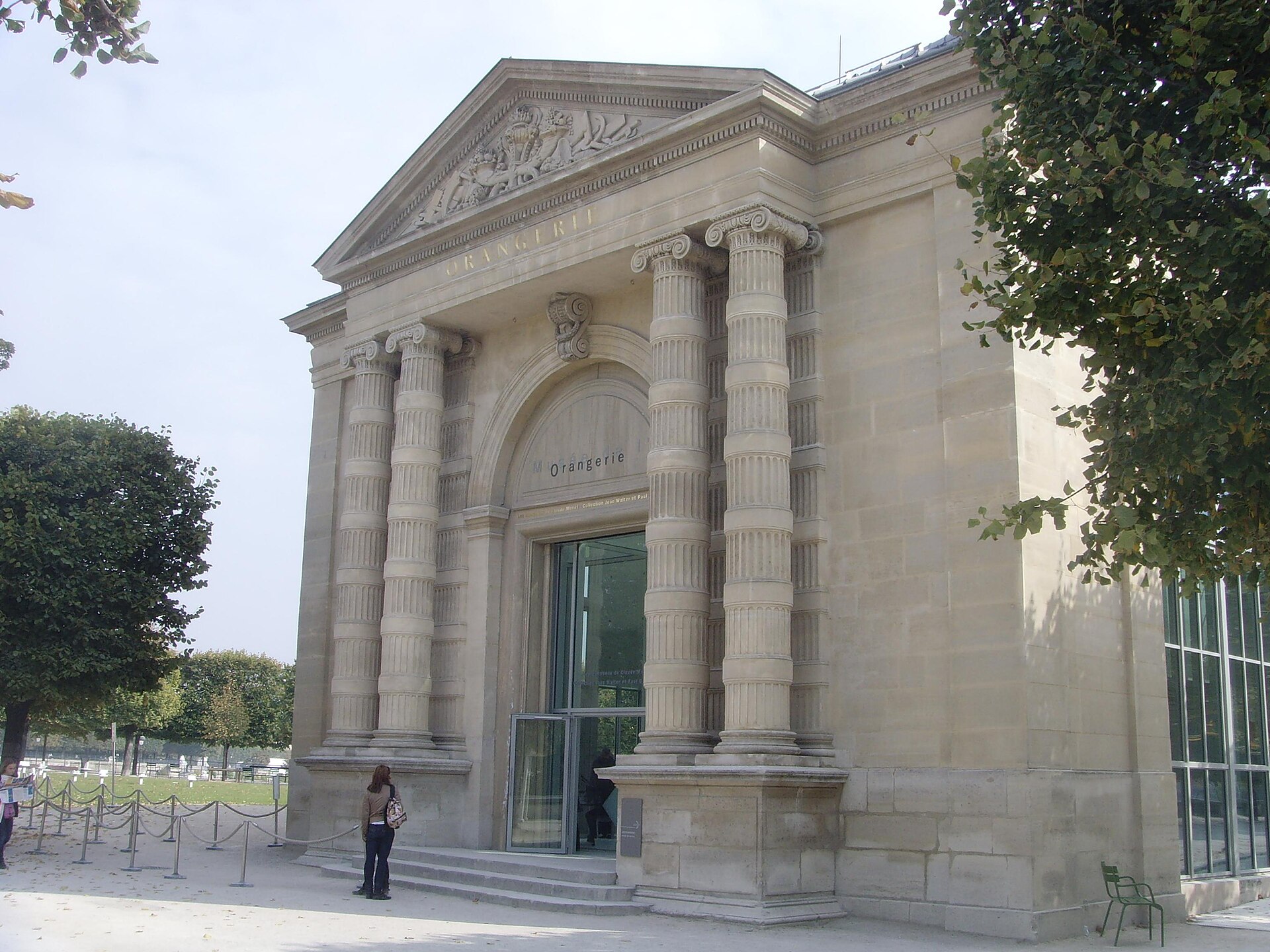
Musée de l'Orangerie
- art-museum
- Price: €12.50
- Opening hours: Wed-Mon 09:00-18:00, closed Tue
History
Architect Firmin Bourgeois built the Orangerie in 1852 as a greenhouse for the Tuileries garden's orange trees, a purely practical structure designed to shelter them through the winter months. Nobody involved could have guessed it would one day house one of the most beloved installations in modern art.
In 1918, the day after the armistice that ended the First World War, Claude Monet offered the French state a cycle of monumental water lily paintings as a gift of peace. He spent his remaining years, working nearly blind from cataracts, adapting and expanding the series specifically for two purpose-built oval galleries here, designed under his close supervision to bathe the enormous curved canvases in natural light. The installation opened to the public in 1927, just months after Monet's death.
Did you know?
Monet intended his water lilies to be experienced as a single, continuous panorama rather than a set of individually framed paintings, and the oval galleries were built specifically to make that possible: walk through the room and the canvases wrap floor to ceiling around you, with no clear beginning or end to the sequence.
Below the Monet galleries, the museum also holds the Walter-Guillaume collection, a trove of early 20th-century painting assembled by art dealer Paul Guillaume and, after his death, by his widow. It's an unexpectedly rich second act to the museum, spanning Cézanne, Renoir, Matisse, Picasso, Modigliani and Soutine.
Good to know
Modest in size compared with the Louvre or the Orsay just across the river, the Orangerie is one of the quickest major museums in Paris to visit properly — an hour or two is enough to see everything without rushing, which makes it a good choice if your time in the city is limited. It's closed on Tuesdays.
Because it sits right inside the Tuileries garden, the Orangerie combines naturally with a stroll through the gardens before or after your visit — allow extra time in fine weather, when the terraces nearby fill up fast.