
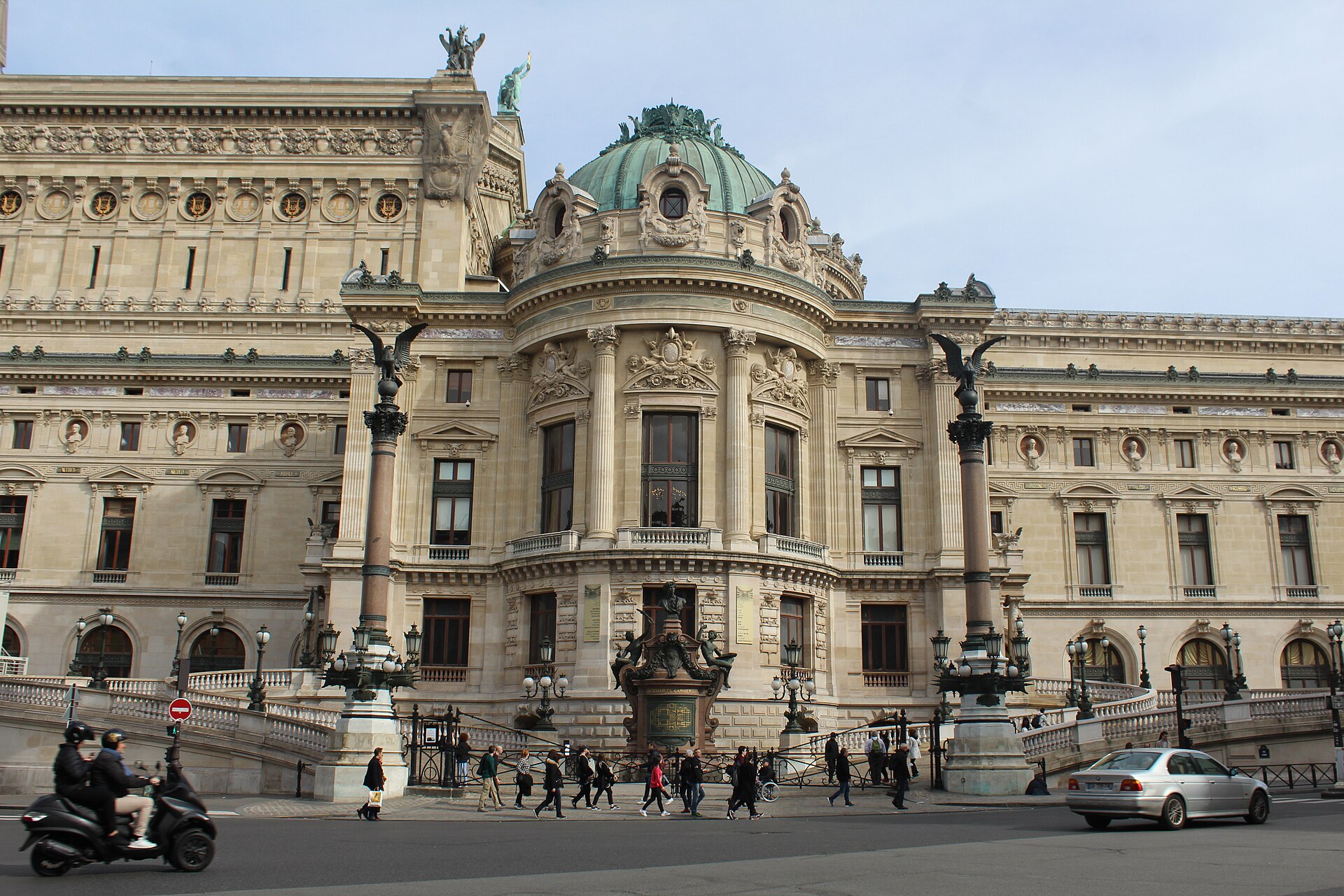
Palais Garnier
- theatre
- design
- Price: €16
- Opening hours: 10:00 - 17:00
History
In 1858, an assassination attempt against Emperor Napoleon III took place right outside the Paris Opera's old home, the cramped Salle Le Peletier, and the emperor responded by commissioning an entirely new, safer opera house worthy of the capital. The competition to design it drew 171 entries and was won, to general surprise, not by an established name but by Charles Garnier, a 35-year-old architect who had never built anything on this scale before.
Garnier's design, an exuberant, deliberately eclectic mix of Baroque, Renaissance and Beaux-Arts influences layered in marble, gold leaf and sculpture, took fourteen years to complete, delayed by the Franco-Prussian War and the upheaval of the Paris Commune. It finally opened in 1875, several years after Napoleon III himself had been deposed and gone into exile — he never set foot inside the building he had ordered built. Garnier designed the grand foyer and sweeping marble staircase as a stage in their own right, a space where Second Empire society could see and be seen before the curtain even rose.
The real Phantom of the Opera
In 1896, a counterweight from the auditorium's enormous chandelier broke loose during a performance and crashed into the audience below, killing one spectator — a real tragedy that partly inspired the falling chandelier scene in Gaston Leroux's 1910 novel The Phantom of the Opera. Leroux set his story in the building's genuine labyrinth of cellars and passages, including an actual underground water reservoir built to contain groundwater encountered during construction, a 25-by-50-metre tank that the Paris fire brigade still uses today for training.
The novel's obsession with Box Five may have its own real-world root: in the late 19th century, a mysterious patron reportedly paid the opera house a monthly sum in exchange for having that exact box reserved for him at every performance, and was rarely if ever seen. Whether or not Leroux knew the story, Box Five now carries a small brass plaque reading "Loge du Fantôme de l'Opéra" in wry homage, and visitors on tours are usually shown exactly where it sits.
Did you know?
Garnier's mash-up of styles baffled contemporaries, including, reportedly, Empress Eugénie herself, who is said to have asked him what style the building even was — not Greek, not Louis XVI, not any style she recognised. Garnier's famous reply was that it was simply "Napoleon III," a joke that also doubled as a fair description of an entirely new architectural language built for a self-confident new empire.
In 1964, French culture minister André Malraux commissioned Marc Chagall to repaint the auditorium's ceiling, replacing Garnier's original with something radically modern and colourful. The project caused such an uproar that Chagall reportedly worked in secret under guard, and as a compromise his ceiling was mounted on a removable panel suspended just above the original 19th-century painting, which survives intact underneath, hidden but preserved.
Good to know
The Palais Garnier today is used mainly for ballet — the Paris Opera's full operatic repertoire is mostly staged at the newer Opéra Bastille — so daytime visits here are largely about the building itself: the auditorium, the grand staircase, the mirrored Grand Foyer, and the small onsite library-museum. Self-guided and guided tours run outside rehearsal and performance hours, so it's worth checking the schedule before planning a visit, since parts of the building close when the venue is in use.
Seeing a ballet performance here is a genuinely different experience from the daytime tour — the auditorium, lit and full, feels like an entirely different building — so if the schedule allows, it's worth considering both rather than just one.