
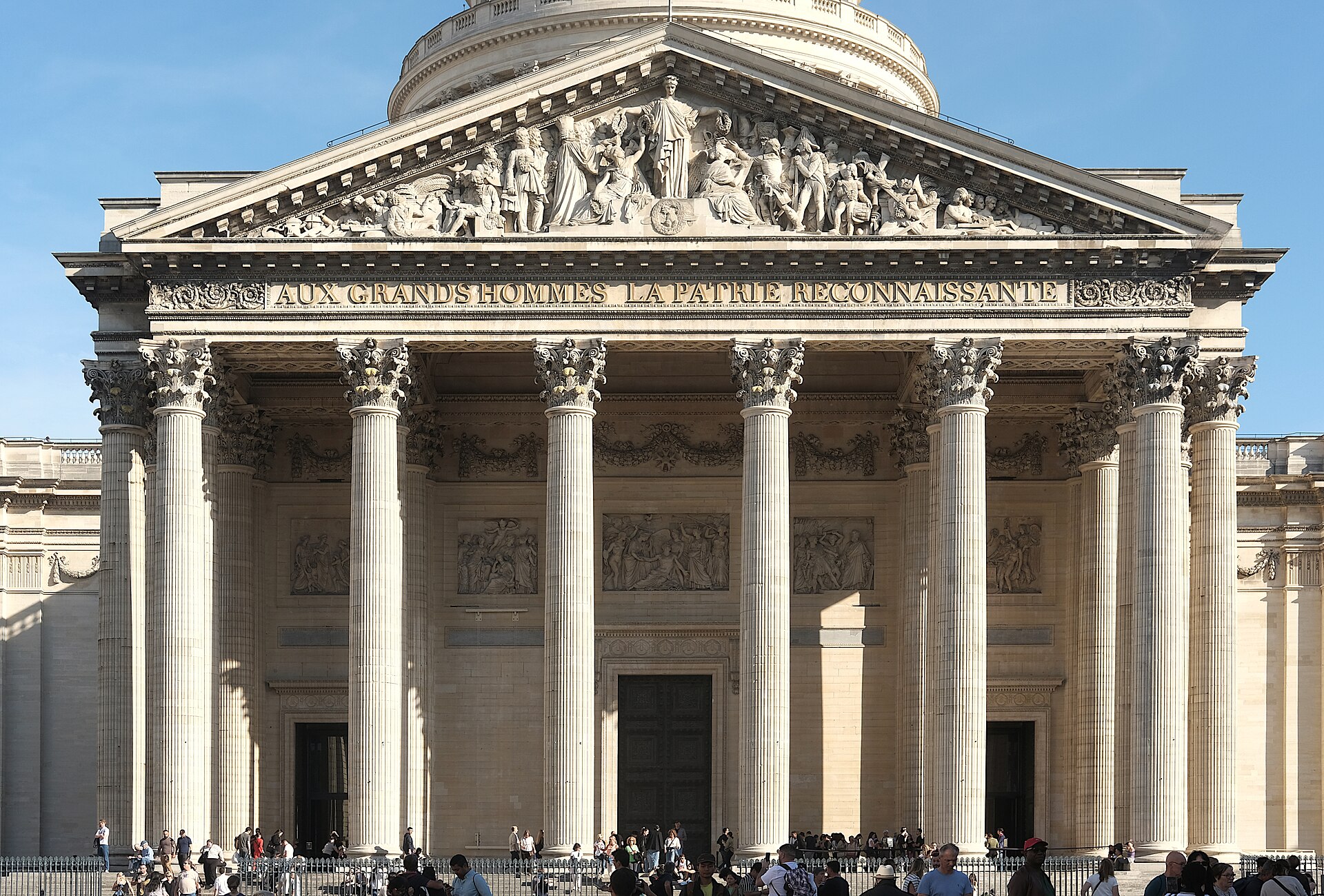
Panthéon
- historic
- Price: €13
- Opening hours: 10:00 - 18:00
History
King Louis XV commissioned the building in 1744 as a church dedicated to Saint Genevieve, Paris's patron saint, after vowing to build it if he recovered from a severe illness. He gave the job to architect Jacques-Germain Soufflot, who designed a vast domed structure explicitly inspired by the Pantheon in Rome and St Paul's Cathedral in London, aiming to combine the lightness of Gothic engineering with the grandeur of classical form.
Construction dragged on for decades and was still unfinished when the Revolution broke out in 1789. The new revolutionary government requisitioned the half-built church and rededicated it as a secular mausoleum for France's great citizens, carving above its columned entrance the inscription "Aux grands hommes, la patrie reconnaissante" — to great men, from a grateful homeland. Over the following century its status flipped back and forth between working church and civic pantheon, following the political currents of 19th-century France, before settling permanently into its secular role.
Did you know?
In 1851, physicist Léon Foucault suspended a 28-kilogram brass-coated bob from a wire hung 67 metres down from the dome and set it swinging. As the hours passed, the pendulum's plane of swing appeared to rotate slowly across the floor — proof, visible to anyone watching, that it was actually the Earth turning beneath it. It was the first experiment to demonstrate the planet's rotation without relying on astronomical observation, and a working replica still swings inside the Panthéon today, recreating the demonstration for visitors.
The crypt beneath the building holds the remains of roughly 80 people France has chosen to honour as national figures, among them Voltaire, Rousseau, Victor Hugo, Émile Zola and Alexandre Dumas. Marie Curie, moved here in 1995, was the first woman interred in the Panthéon for her own achievements rather than as someone's wife — a distinction that took over two centuries of the building's history to arrive.
Good to know
A single ticket covers both of the building's headline draws, so it's worth allowing enough time to see the Foucault pendulum demonstration in the main hall and to walk the crypt below, which is larger and quieter than most visitors expect. The nave itself is also worth lingering in — its scale and the murals covering its walls are easy to rush past on the way down to the crypt.
Between roughly April and October, a separate ticket allows access to the dome's exterior colonnade, reached by a narrow staircase of over 200 steps, with panoramic views over the Latin Quarter. It closes outside that season and can shut on short notice in poor weather, so treat it as a bonus rather than something to plan a visit around.