
Place de la Concorde
- piazza
- Price: Free
- Opening hours: Always open (square)
Book a guided tour of Paris
Skip the line and see Paris with a local guide.
History
Architect Ange-Jacques Gabriel laid out the octagonal square in the 1750s to display an equestrian statue of King Louis XV, naming it Place Louis XV in his honour. Gabriel deliberately positioned it at the edge of the city, away from the dense, potentially unruly streets of central Paris, a layout meant to keep the king's image at a safe, dignified distance from the crowd.
That distance didn't protect it for long. During the Revolution the square was renamed Place de la Révolution, the royal statue was pulled down, and a guillotine was installed that carried out more than 1,100 executions between 1793 and 1795, including that of King Louis XVI and, before the Terror had run its course, several of the revolutionaries who had sent others to it. In 1795, with the bloodshed over, the square was renamed a final time to Place de la Concorde, meaning "harmony" or "concord," a deliberate gesture of reconciliation.
Did you know?
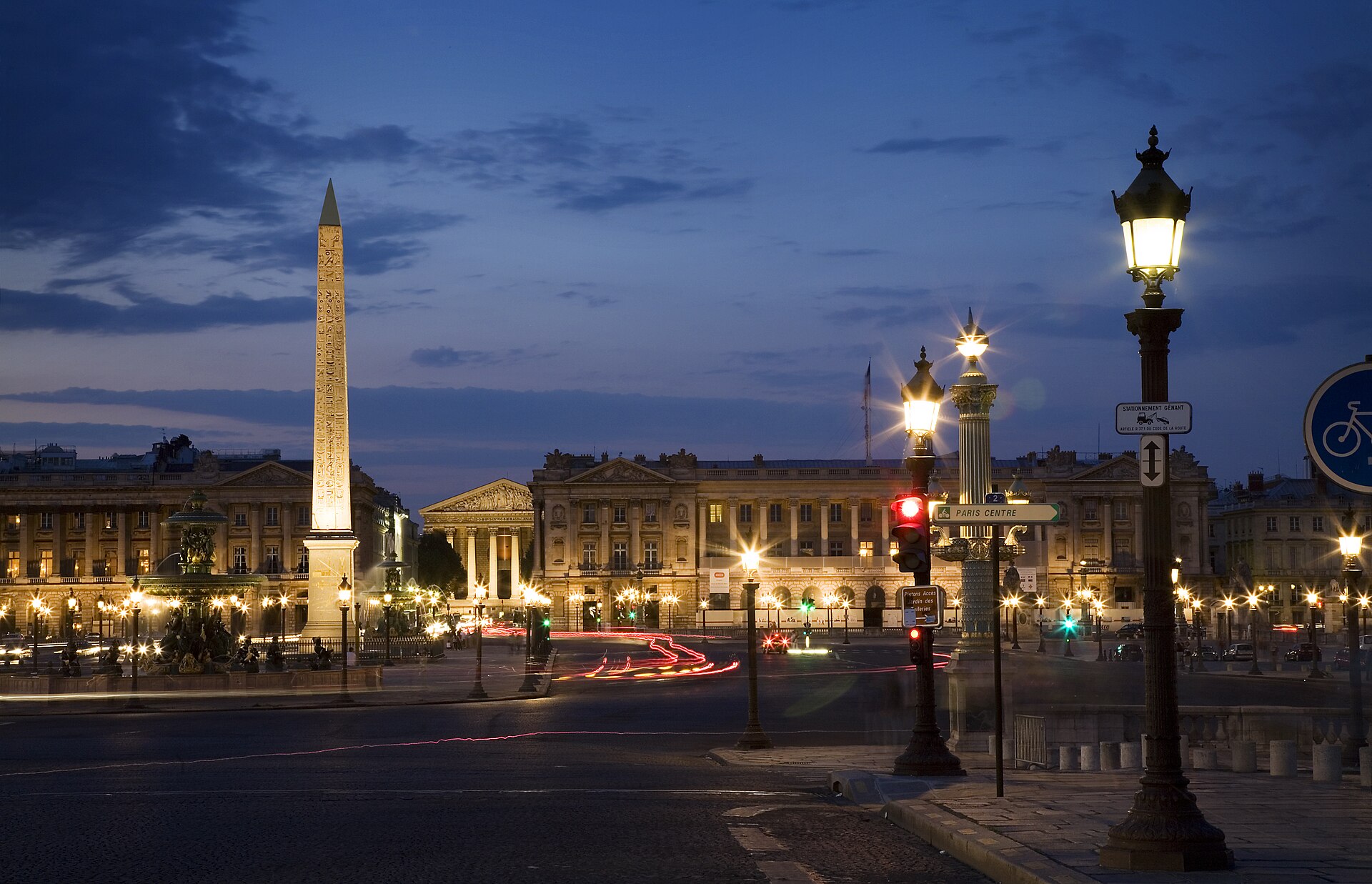
At the centre of the square stands the Luxor Obelisk, a genuine ancient Egyptian monument over 3,300 years old, covered in hieroglyphs recounting the reign of Ramesses II. It was gifted to France in 1830 by Muhammad Ali, the viceroy of Egypt, as a gesture of friendship; in exchange, France sent back a mechanical clock for the citadel in Cairo that, in a twist historians still enjoy pointing out, never actually worked.
The square is also ringed by eight statues, each personifying a major French city, and framed by two grand fountains added in the 19th century. Its position gives it some of the best sightlines in Paris: straight down the Champs-Élysées to the Arc de Triomphe in one direction, and across the Tuileries Garden to the Louvre in the other.
Good to know
Place de la Concorde is free and open at all times, with no ticket or booking required — it's simply the largest public square in Paris, and one of the most historically loaded. That said, the openness that makes it so striking also makes it genuinely difficult, and dangerous, to cross: it sits at the meeting point of several major roads carrying constant, fast-moving traffic.
Use the marked pedestrian crossings and underpasses rather than trying to cut across directly. It takes a little longer, but it's the only sensible way to reach the obelisk at the centre on foot.