
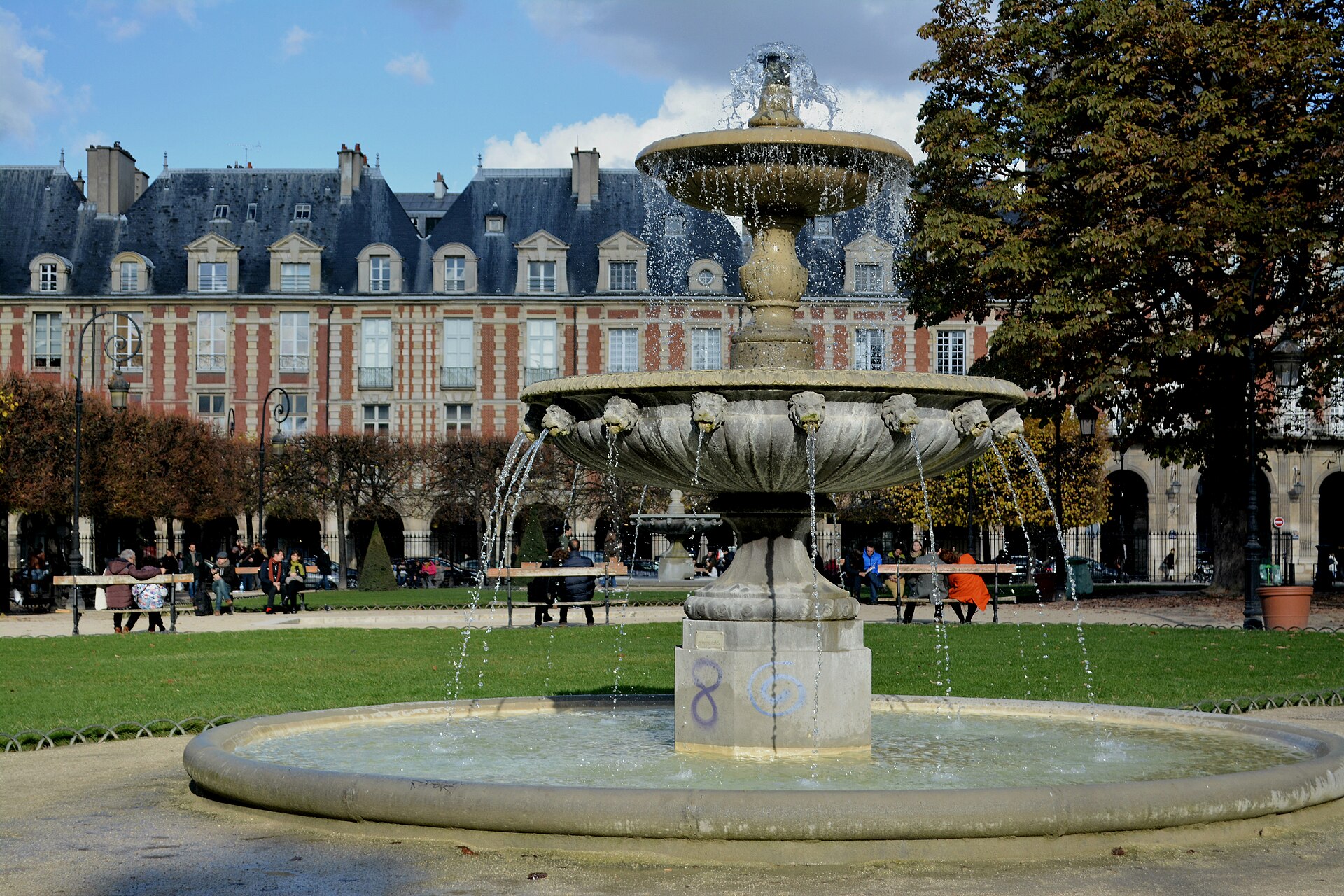
Place des Vosges
- piazza
- Price: Free
- Opening hours: Always open (square)
Book a guided tour of Paris
Skip the line and see Paris with a local guide.
History
In 1605, Henri IV ordered the construction of a residential square on the site of the ruined Hôtel des Tournelles, a royal palace that had stood just north of the plot and doubled as a jousting ground. The palace's fate had been sealed decades earlier: Henri II died there in 1559 of injuries sustained during a joust, and his widow Catherine de' Medici, unable to bear the place, had it demolished. Henri IV envisioned pairing the new square's housing with a silk-manufacturing works nearby, hoping to establish a homegrown luxury industry, but while that industrial ambition quietly faded, the residential plan succeeded on a scale no one had attempted in Paris before.
Completed in 1612, four years after Henri IV's assassination, the square was built as a strict architectural experiment: 36 nearly identical pavilions in red brick and pale stone, arranged symmetrically around a central garden, with a continuous arcade running along the ground floor on all four sides. It was Paris's first planned residential square, and the formula — uniform facades framing a shared garden — became a template that later shaped grand squares elsewhere in Europe, from London's Covent Garden to countless smaller schemes across the continent.
Did you know?
Originally christened Place Royale, the square hosted royal festivities, duels and fashionable promenading through the 17th and 18th centuries. It only took its present name in 1800, when it was renamed Place des Vosges to honour the Vosges département, the first in France to fully pay its revolutionary war taxes — a reward for civic virtue that has stuck as the square's name ever since, long after most Parisians have forgotten why.
The square's most famous resident was Victor Hugo, who lived at number 6 for sixteen years, from 1832 to 1848, writing much of Les Misérables during that time. His apartment is preserved today as the Maison de Victor Hugo museum, with the permanent collection normally free to visit — a quiet, literary detour a few steps from the garden he once looked out on.
Good to know
The square costs nothing to visit and is open around the clock, its lawns and linden trees offering one of the calmest, most photogenic spots in the Marais — a welcome pause from the crowded shopping streets that surround it. The arcades along the perimeter shelter small galleries, cafés and antique shops, making it easy to combine a sit on a bench with a slow wander under the stone vaults.
The Maison de Victor Hugo, right on the square at number 6, makes a natural add-on: its permanent collection is normally free, and a visit rarely takes more than an hour. Mornings and early evenings tend to be quietest, especially on weekdays, while weekend afternoons draw picnicking locals and tourists alike.