
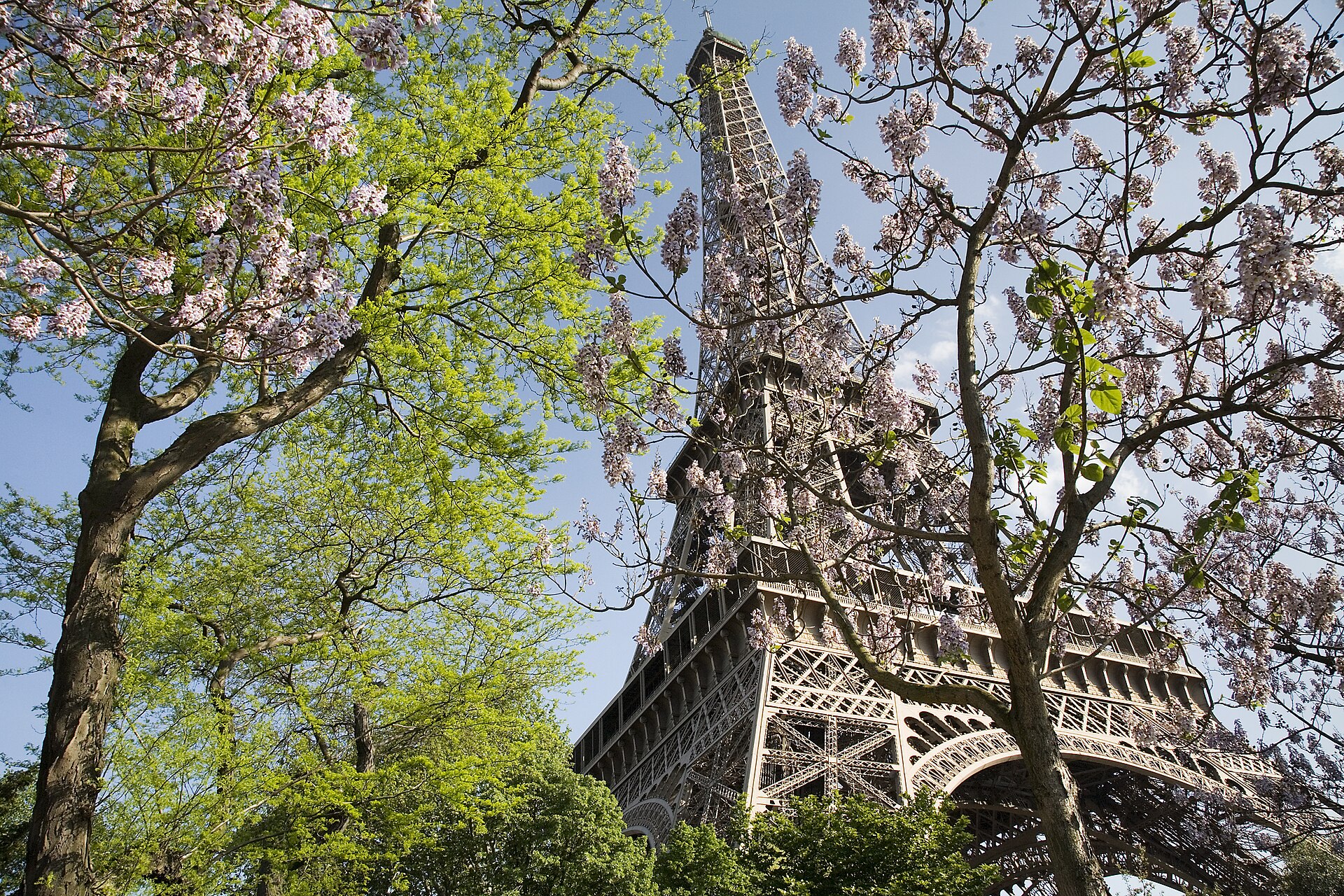
Eiffel Tower
- monument
- viewpoint
- Price: €12 - €35.30
- Opening hours: 09:00 - 23:45
History
Engineer Gustave Eiffel's firm designed the tower as the entrance arch for the 1889 Exposition Universelle, marking the centenary of the French Revolution. Chosen from over a hundred submissions to a design competition, it went up in just over two years, an extraordinary pace for a structure with no real precedent. When it opened, it was the tallest man-made structure on Earth, a record it held for more than four decades.
The reception was not warm. Parisian artists and writers signed a public petition denouncing the "monstrous" iron giant before it had even opened, and the city itself hedged its bets: the tower's building permit ran for only twenty years, with dismantling planned for 1909. It escaped that fate because Eiffel had equipped it with a radio antenna of clear military value, and the tower went on to carry the transmitters that made it useful for telegraphy, then television, then civil defense — practical arguments that, every time demolition resurfaced as an option, tipped the debate decisively in its favor.
Engineering
About 7,300 tonnes of puddled iron, 18,038 individual parts and 2.5 million rivets went into the structure, nearly all of it prefabricated off-site to a tolerance of a tenth of a millimetre so that riveting teams could assemble the framework on site without reworking a single piece. That kind of precision manufacturing was almost unheard of in the 1880s.
The open lattice was the real insight: rather than building a solid mass, Eiffel's engineers calculated a curved profile that lets wind pass through the structure instead of pushing against it, so the tower sways only a few centimetres at the top even in strong gusts. It's this obsessive precision, more than sheer size, that has let a 330-metre iron structure stand for over 130 years with nothing more than routine maintenance and a repaint roughly every seven years.
Did you know?
Eiffel built himself a private apartment near the summit, furnished with a piano, a workshop and a dining room, though notably no bed. He used it to take meteorological readings and to entertain VIP guests, most famously Thomas Edison, who visited in September 1889 and gave Eiffel one of his patented phonographs as a gift. The room survives largely as it was, and today's summit visitors can see it re-created with wax figures of the two men.
After dark, the tower sparkles for five minutes at the top of every hour, a light show distinct from its steady golden illumination. And despite around seven million visitors a year, it isn't Paris's most-visited monument outright — free sites like Sacré-Cœur draw more total footfall — but it is, by a wide margin, the most-visited paid monument on Earth.
Good to know
Book timed entry online well before you travel, especially for summit access, which sells out fastest in high season. Climbing the stairs to the first two levels is cheaper than the lift and an experience in its own right; only the lift goes all the way to the summit.
Expect an airport-style security check at the base before you're allowed onto the esplanade, so arrive with a little time to spare and keep bags light. If you're visiting in the evening, time your arrival for the top of the hour after nightfall to catch the tower sparkling.